
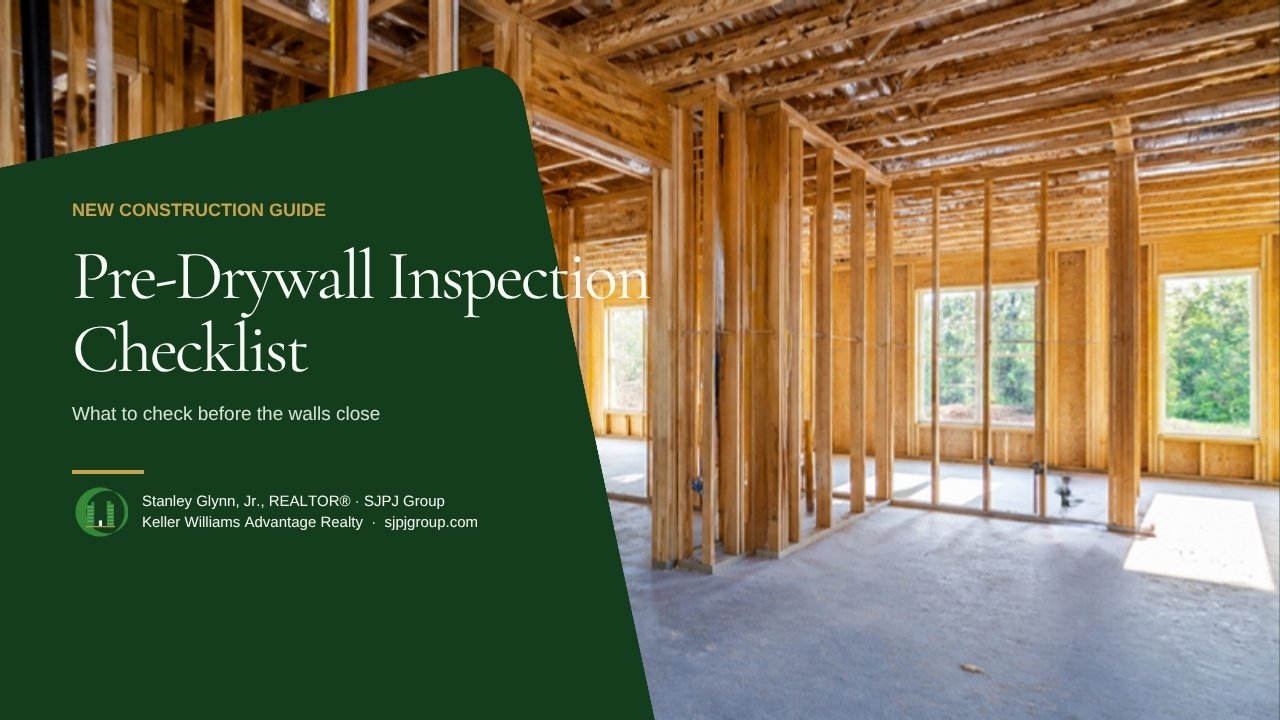
A pre-drywall inspection is a walkthrough of your new build after the framing, plumbing, electrical and HVAC rough-in are done but before insulation and drywall close the walls. In Texas it is not a standard TREC inspection — the Standards of Practice set minimum requirements for a home that is substantially completed, and a house with open walls is not that — so the scope is whatever you and your inspector agree to in writing.
Honestly, this is the cheapest hour you will ever spend on a new build. Everything a standard inspection is allowed to skip because it is buried in a wall is, right now, hanging in the open with a light on it. Miss the window and it is gone behind sheetrock for thirty years. If you are still choosing a builder or a community, start with my new construction guide, then come back here for the walk itself.
🧱 1. Why TREC’s rulebook does not cover this visit
The Texas Real Estate Commission writes the Standards of Practice that govern home inspections, and the scope rule is narrow on purpose. Section 535.227(a)(2) sets minimum requirements for an inspection of a one to four family unit that is substantially completed, which the rule defines as the stage when a building can be occupied or used for its intended purpose. A framed shell is not there yet.
That does not make the visit improper — it makes it optional and unregulated. Section 535.227(a)(4) says the standards do not prohibit an inspector from providing a higher level of inspection or inspecting additional components, as long as the inspector has the competency to do so. So you are hiring a licensed Texas inspector to do something the rulebook neither requires nor forbids. Get the scope and the deliverable in writing before anyone drives out. And know that when that same inspector does your final inspection later, TREC requires the completed Property Inspection Report Form (REI 7-6) to come first, with any additional report layered on top of it.
🔎 2. The one rule that makes this worth paying for
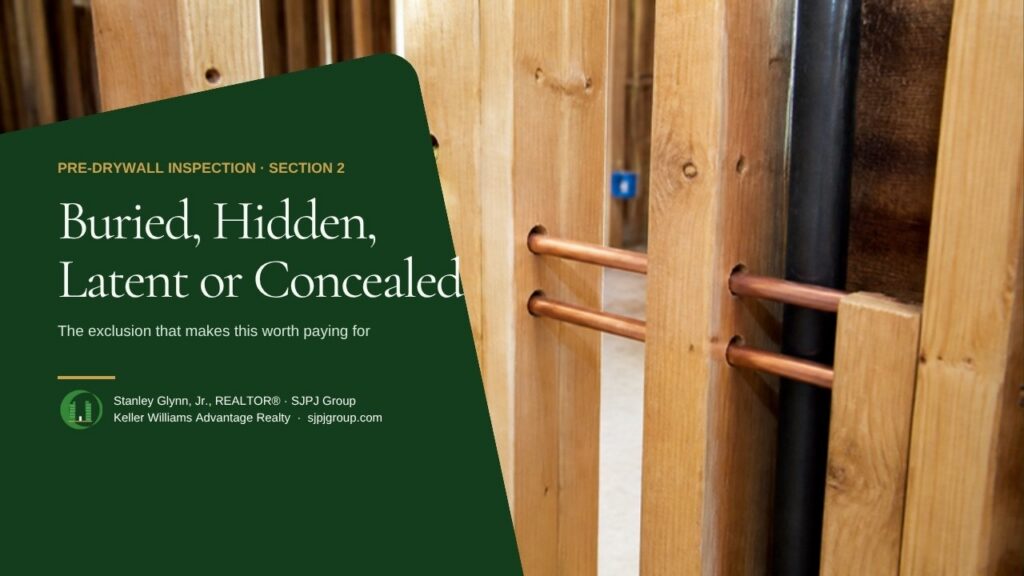
Here is the argument in a single line. Section 535.227(d)(1) says an inspector is not required to inspect anything buried, hidden, latent or concealed. The standards only reach components that are accessible, meaning ones that can be approached or viewed without hazard, without moving obstacles and without damaging property.
Read that twice. The entire list of things your final inspection is excused from — wall framing behind drywall, the pipe runs inside the chases, the wiring between boxes, the flashing under the cladding — is sitting in plain sight on the day the rough-in passes. The rules even let an inspector skip a crawl space with less than 18 inches of headroom and an attic opening smaller than 22 by 30 inches. None of that is a knock on inspectors. It is just the difference between a finished house and an open one.
📋 3. The checklist: structure, water and fire separation
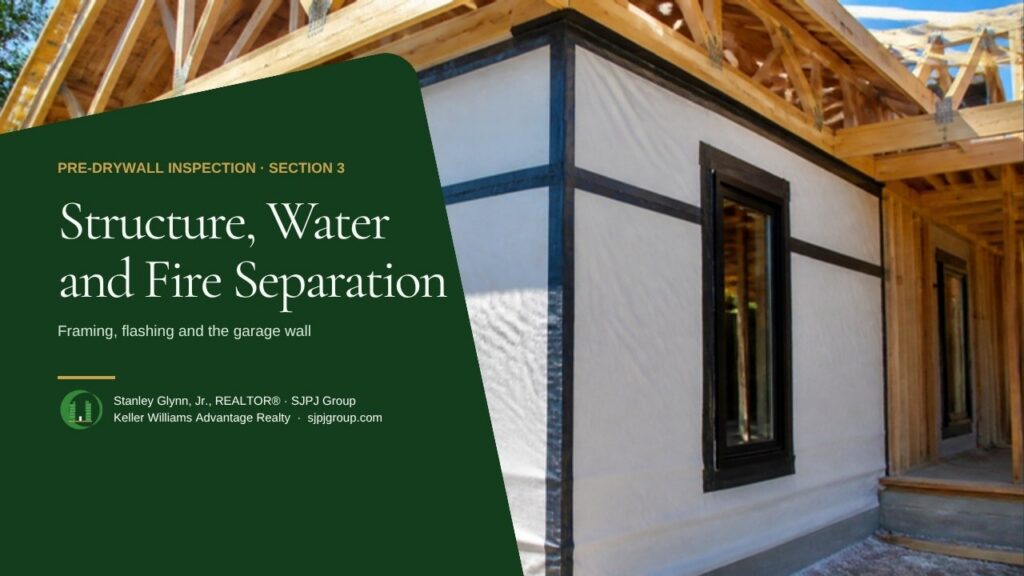
The Standards of Practice are the best free checklist in Texas, because they spell out what counts as a deficiency. Borrow the structural list and point it at open framing. For foundations, Section 535.228(a)(1)(D) names deteriorated materials, deficient components such as beams, joists, piers, posts, columns, sills and subfloor, and exposed or damaged reinforcement. For grading and drainage, 535.228(b)(1) names grade deficiencies around the foundation and foundation drainage that is not performing.
Above that, 535.228(d)(1)(B) covers deficient installed framing members and decking and missing insulation; 535.228(e) and (f) cover water-penetration deficiencies, deficient exterior claddings, flashing and water-resistant materials, and — the one people forget — missing or inadequate fire separation between the garage and the living space or attic. Fire separation is a drywall assembly. If it is wrong, you want to know the day before it is hidden, not the day after.
⚡ 4. The checklist: electrical, plumbing and ducts
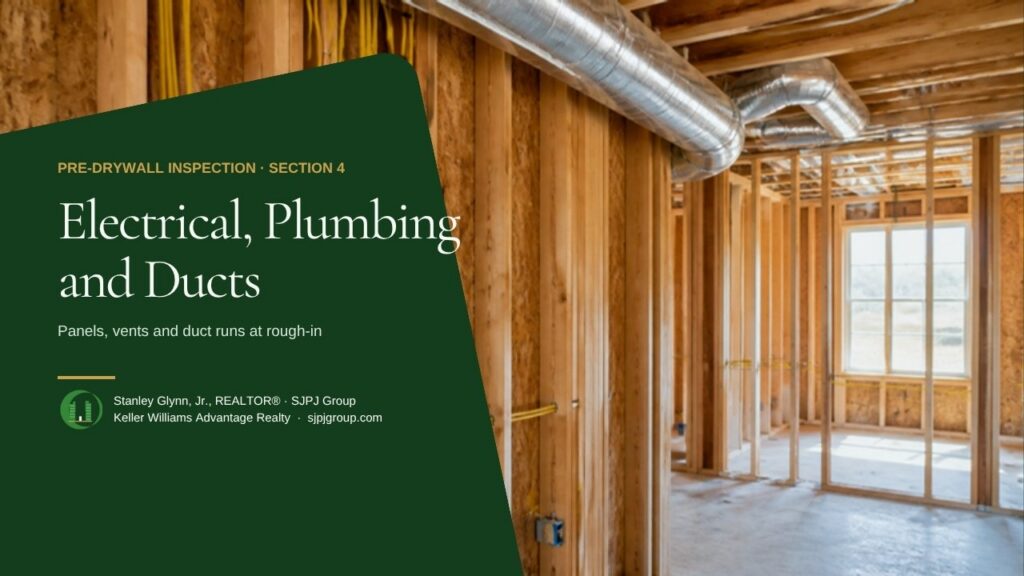
Panel and service first. Section 535.229(a)(1) flags an absent or deficient grounding electrode system, panels in unsuitable locations or without 36 inches of clearance, deficient bonding, grounding and conductors, and missing anti-oxidants on aluminum terminations. Then branch circuits: 535.229(b)(1)(C) covers deficient wiring and junction boxes, GFCI protection in the listed locations, AFCI protection in the listed rooms, and smoke or carbon monoxide alarms where required. At rough-in you can see where every box and home run actually landed.
Plumbing next: 535.231(a)(1)(B) covers deficient supply and waste pipes and deficient vent installation or termination. Those vents disappear into walls and roof lines; this is your only clean look. Then ducts, under 535.230(c)(1): damaged or improper duct material, damaged or missing duct insulation, ducts or plenums in contact with earth, and gas piping or sewer vents concealed in ducts, plenums or chases. Walk the attic runs and the chases with a flashlight while they are still reachable.
🏛️ 5. Who else is checking — and who is not
People assume somebody from the government already looked. Sometimes. Inside a city, Texas Local Government Code Section 214.212 adopts the International Residential Code as the municipal residential building code, covering construction, alteration, remodeling, enlargement and repair of residential structures in a municipality; a city can amend it, but only after a public hearing and by ordinance. That is a real permit-and-inspection process with a real inspector.
Outside city limits the picture changes. For unincorporated areas of the counties it covers, Local Government Code Section 233.153 requires new single-family houses and duplexes to conform to the International Residential Code, for construction beginning after September 1, 2009 — and then says the county may not charge an enforcement fee and that the subchapter does not require the county to approve new residential construction in advance. A standard that exists and a person who shows up to verify it are two different things. Ask your builder, in writing, which jurisdiction permits your lot and which inspections it actually performs. And note that TREC does not require inspectors to inspect to any of the various building codes, and 535.227(d)(3) specifically excuses them from determining code compliance — so your inspector is not a substitute for a code official either.
🧾 6. What to actually do with the findings
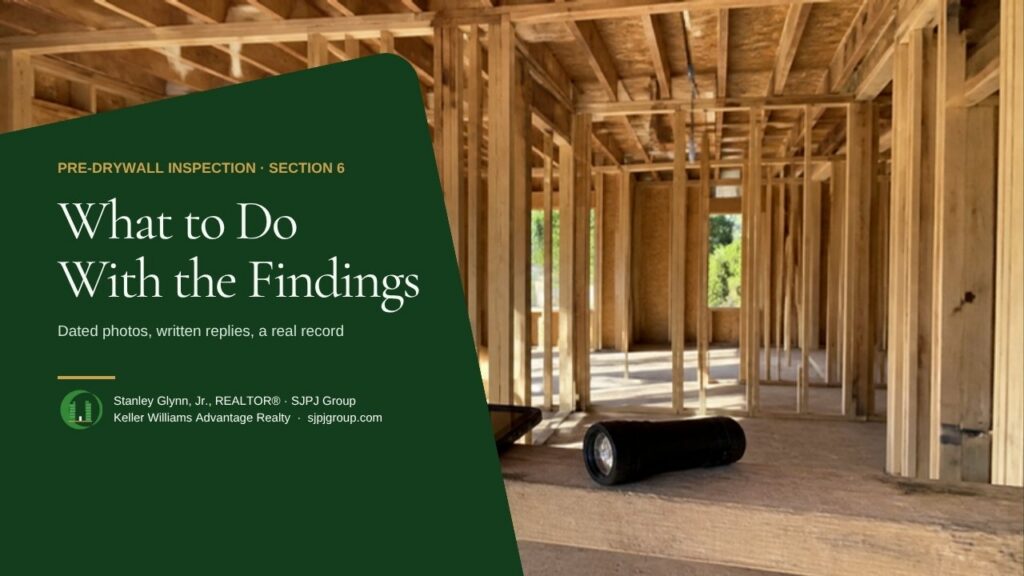
Ask for the report as dated, captioned photographs, one item per issue, delivered to you and to your builder the same day. Then let the superintendent respond in writing. Most of what turns up at rough-in is ordinary and gets corrected in an afternoon, because nothing has been covered yet. That is the entire point of the timing.
Here is the honest caveat: a pre-drywall inspection does not obligate your builder to do anything. No Texas rule makes it binding. What it builds is a record. If a disagreement ever hardens, Texas Property Code Section 27.004 requires a claimant to give the contractor written notice by certified mail, return receipt requested, specifying the construction defects in reasonable detail, at least 60 days before filing suit; the contractor may request up to three inspections during the 35 day period after receiving it, and must make any written settlement or repair offer by the 60th day. Rejecting a reasonable offer can cap what you recover. A photographed rough-in file is what that notice gets written from — and far more often, it is what keeps you from ever needing one.
In my experience: This is a big one. I have had clients who feel that because they are having a house built or it is “new,” a third-party inspection is not necessary or is a waste of money. Two different clients: one did the pre-inspection and found moisture accumulation in the attic that would have been totally missed without the inspection, and another client decided the cost of it wasn’t worth it, and they soon found out. The house was bought in the summer, so the builder didn’t test the furnace, and as soon as it got cold and they tried it… No heat. Come to find out, the heating element was never installed. Fortunately, because of the relationship I have with the builder, they came out and fixed it for free.
Where to start
If you are under contract on a build, send me your rough-in schedule and I will tell you where the pre-drywall window falls and what to ask the superintendent for. Still shopping? Browse live Montgomery County listings and read the new construction guide first — the model home conversation goes very differently when you already know what you intend to inspect. Buying your first? The first-time home buyer guide covers the money side, and if you are moving in from out of state, the relocation guide covers the area.
Already own here and wondering where you stand? Get a real MLS valuation rather than an automated guess — Texas is a non-disclosure state, so the sale prices you see online are estimates, not records. Call (832) 730-2595 and someone answers 24/7, or text me at 346-368-1082. You can also send a message here.
Honestly, don’t take my word for it. Read what my clients wrote, in their own words, where they wrote it: Google reviews · HAR.com ratings · Zillow reviews.
❓ Quick answers
Is a pre-drywall inspection required in Texas?
No. Nothing in state law requires one, and it is not a standard TREC inspection either. The Texas Real Estate Commission Standards of Practice set minimum requirements for an inspection of a one to four family unit that is substantially completed, which the rule defines as the stage when a building can be occupied or used for its intended purpose. A house with open walls is not there yet. You can still hire a licensed Texas inspector, because the standards do not prohibit an inspector from providing a higher level of inspection or inspecting additional components when the inspector has the competency to do so. Put the scope in writing before the visit.
When should a pre-drywall inspection be scheduled?
After the framing, plumbing, electrical and HVAC rough-in are complete, and before insulation and drywall go up. That window is short on a production build, so ask your builder for the rough-in dates in writing and book the inspector as soon as you have them. Once the walls are closed, the Standards of Practice do not require an inspector to examine anything buried, hidden, latent or concealed, so most of what a pre-drywall visit covers is no longer visible.
Does a pre-drywall inspection make my builder fix anything?
Not by itself. What it gives you is a dated, photographed record while the work is still cheap to correct. If a dispute goes further, Texas Property Code Section 27.004 requires a claimant to give the contractor written notice by certified mail, specifying the construction defects in reasonable detail, at least 60 days before filing suit, and the contractor may request up to three inspections during the 35 day period after receiving that notice. Your report is what that notice gets written from.
Stanley Glynn, Jr., REALTOR® · Keller Williams Advantage Realty · TREC #818067. Verified 2026-11-05 against the Texas Real Estate Commission (Standards of Practice, 22 TAC Sections 535.227 through 535.231, and the consumer article on Texas property inspections), Texas Local Government Code Sections 214.212 and 233.153, and Texas Property Code Section 27.004. Rules, code editions and local permitting practice change, and the inspection standards cited here are written for substantially completed homes; confirm the current rules, your builder’s schedule and your own deadlines with your agent, your inspector and your attorney. This is general information, not legal, engineering or construction advice.


Leave a Reply